Inicio | Secondary (ESO)

Secondary education (ESO, ages 12–16) in Sarrià

We consolidate our pupils’ academic and personal development in an international environment, giving them a solid foundation for their future.
Request information
Paso 1 de 2
Paso 2 de 2
Contact details
Pupil details

NEXT
Back

Our educational approach

We support and guide each pupil in getting to know themselves and understanding their great potential. At RMSI, pupils consolidate the skills and techniques they need for independent learning and for developing their abilities.

Bilingual secondary education in Sarrià: we educate pupils with a global outlook

An international education

33% of teaching time is delivered in English by native-speaker or bilingual teachers. Pupils receive personalised preparation for Cambridge Assessment English qualifications such as the First Certificate (B2), Advanced (C1) and Proficiency (C2).

They also learn to use English in a practical way through subjects such as Science, Technology and Economics, applying the language in different fields and contexts. Pupils can also choose to study a fourth language (French or German) and sit exams at B1 or B2 level.

From 3º de ESO (age 14–15), we offer the American Dual Diploma programme (Bachillerato Dual Americano) to pupils who wish to enrich their studies with a dual curriculum. The programme allows them to obtain the US High School Diploma alongside their Spanish qualification, preparing them for a competitive global market.

We also offer one-term and full-year exchanges, as well as summer camps in the USA, Ireland and Switzerland, through our OAK Academies.

Academic excellence

Experiential and interdisciplinary learning

Scientific and mathematical learning

Scientific and mathematical competence is central to our curriculum, fostering curiosity and knowledge through:

  • Projects and laboratory work: taking part in science fairs and external competitions to discover, learn and understand.

Language competence

  • Reading comprehension and written expression: we work on these in the language subjects (Catalan, Spanish and English) and across all subjects, through understanding complex texts, identifying key information, and relating and synthesising concepts.
  • Public speaking: pupils develop the skills to speak well through practical training, learning to work on empathy, defend their opinions, seek and defend the truth, question reasons, discover logic, look for evidence, and improve their non-verbal and assertive communication. This programme strengthens critical thinking and the ability to communicate effectively.

Critical thinking

Developing our pupils’ critical thinking is a priority at this stage. We build on the thinking strategies begun in Primary, using routines and skills that foster effective, visible thinking. We educate our pupils to become passionate seekers of the Truth.

This intellectual challenge involves applying skills to analyse, reflect, compare, discern, explain and make decisions based on information, in line with their hierarchy of values.

Through this training in critical thinking, pupils learn to:

  • Question the opinions of others: evaluate and analyse other people’s ideas and points of view.
  • Distinguish between opinion and information: identify what is true and what is not.
  • Form their own opinion: develop informed judgements about the world around them.

Study skills

Study skills workshops are run in collaboration with the Educational Psychology and Guidance Department.

Throughout this stage, we work on:

  • The ability to link new learning to prior knowledge
  • Visual thinking
  • Outlines and mind maps

Alongside all this, we encourage regular study, both independently and in groups, and effort as the path to self-improvement.

Personal accompaniment for every pupil

Committed to an all-round education (formación integral)

Careers guidance: we help pupils discover their vocation through a programme that identifies their gifts and opportunities, offering a wide range of subjects from Secondary onwards and a specific programme in 3º de ESO (age 14–15).

Education for love: We help pupils understand the true value and meaning of their body, affection and sexuality. To do this we use the “Aprendamos a Amar” (“Let’s Learn to Love”) programme, endorsed by the UFV (Universidad Francisco de Vitoria).

Parents’ School (Escuela de Padres): we offer parents ongoing sessions with experts on the issues that interest and concern them, as well as a place to come together and reflect as a group on the task of educating their children and on other current topics.

Virtues programme: we encourage our pupils to acquire essential virtues through formative activities adapted to each year group, focusing on values such as order, friendship, generosity, effort and respect.

Formative discipline: our educators work so that pupils discover, day by day, the values behind the rules, so that they act out of personal conviction rather than because a set of rules has simply been imposed on them.

Committed pupils

Social engagement

Our pupils work with charities and social organisations in areas such as the defence of life, social inclusion, care for the elderly, protecting the environment and the fight against poverty.

The “One to One” programme allows our Secondary pupils to give academic support to Primary pupils who need it. The programme teaches them to serve others and fosters attitudes such as empathy, gratitude, humility and generosity.

In ESO, we want pupils to take on ever greater social responsibility by committing to social projects run by a range of organisations.

In 4º de ESO (age 15–16), we encourage social engagement through Service-Learning (APS) projects, which integrate social action into the academic curriculum while improving the local community through projects that respond to real needs.

Digital pupils

Pupils equipped for the digital and technological age

We work with a balance of analogue (books and exercise books) and digital (devices) media; combining both ways of working is ideal for the learning process.

We introduce technology as a cross-curricular tool, gradually and adapted to each stage. We want our pupils to learn to live with technology responsibly, thoughtfully and creatively.

Key features of our state-subsidised Secondary (ESO) education

At Secondary, we take into account the profound physical, intellectual and emotional changes that come with this age. Our educational model centres on personal accompaniment in every dimension (one-to-one guidance and support), educating responsible, competent people with a strong human commitment rooted in Christian love.

At this stage:
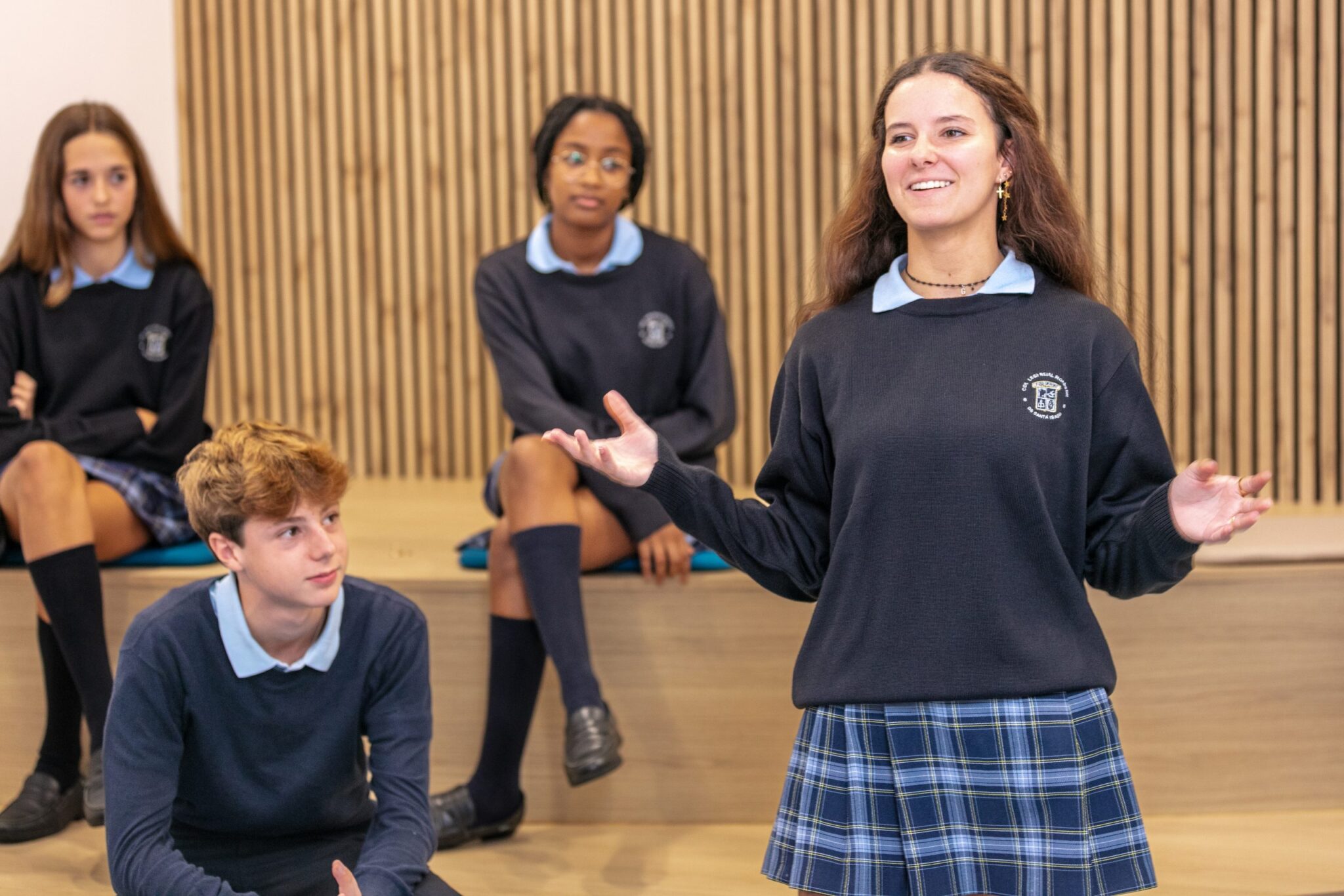
  • We aim for meaningful learning, using active learning methodologies that develop skills for real life.
  • We combine educational innovation with scientific rigour and strong language and maths skills.
  • Pupils prepare for Cambridge exams up to the Certificate of Proficiency in English (C2).
  • They consolidate the habits needed for an excellent Sixth Form (Bachillerato).
  • We offer individual support on a personal, academic, psycho-educational and spiritual level.
  • Pupils take part in external competitions and in a personal development programme that includes tutorials, relationships and sex education, and careers guidance.
Find out more
Close

A day in our secondary school in Sarrià

At our school, a secondary pupil’s day is full of opportunities to grow and learn. The day begins with bilingual lessons that combine English with subjects such as science and technology, using active learning methodologies that encourage critical thinking and creativity.

Throughout the day, pupils take part in interdisciplinary projects and formative activities that bring together academic knowledge and personal development. This is complemented by careers guidance and emotional development programmes, supported by one-to-one tutorials.

Pupils also have the opportunity to take part in competitions and extra-curricular activities, applying their skills in real-life contexts. This all-round approach prepares them to face future challenges with confidence and competence.

Find out more
Close

Accreditations

Request information